
InQorix for Mac: User Guide
Installation, models, files, settings, and troubleshooting for InQorix 0.7.
Getting-started guide · Downloads and release requirements
Select a screenshot to enlarge it. Press Esc or choose Close image to return to the guide.
Contents
Web edition for InQorix 0.7. Screenshots show earlier builds and may contain older names or version numbers. With a local model and online features off, chat runs on your computer. Company servers, InRag, web search, model downloads, MCP tools, code runs, and generated previews can use the network. See the app data-flow table.
InQorix is a chat assistant for your Mac. You ask questions in plain language, and an AI model answers. It can also look things up in your organization's documents or on the web, and it shows you exactly where each part of the answer came from.
With a local model and online features off, chat runs on your Mac using its processor and graphics chip. If you choose a company model server, the conversation and context it needs go to that server. Other features can also send data; see the app data-flow table.
You don't need any technical knowledge to use it. This guide covers everything, from installing the app to its advanced settings.
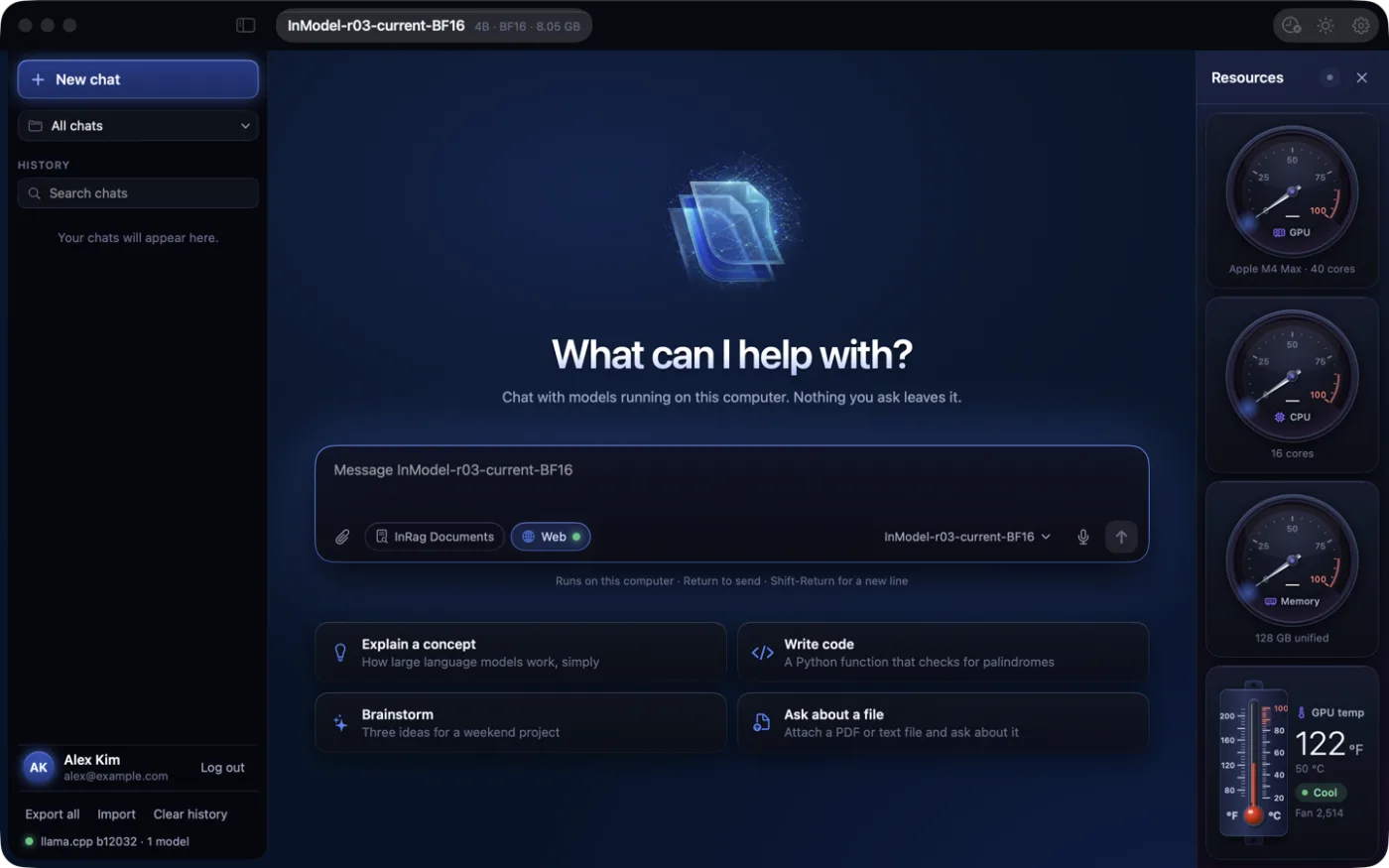
Earlier-build example; displayed names and versions are not release specifications.
Why InQorix
1. You choose where each answer comes from.
An AI model on its own only knows what it learned when it was made. That knowledge is frozen in time, and it has never seen your organization's policies, agreements, minutes or forms. Asked about them, it can only guess, and its guesses can sound convincing.
For each question, you choose where the answer should come from:
| Switch in the message box | The answer comes from |
|---|---|
| InRag Documents | Your organization's documents: the passages that match your question, quoted with their source |
| Web | The web, for current or general information, with the pages it used |
| Both on | Your documents first; the web only when your documents have nothing on it |
| Both off | The model's own knowledge only, frozen at its training date |
When an answer comes from documents or the web, it lists its Sources, so you can check every part of it (section 8).
2. Everything is in the app.
There is nothing else to install: no server, no Python, no Docker, no extra packages. The AI engine (llama.cpp, with Apple's Metal graphics) is inside the app. You add a model from the app's own model browser, and you're ready.
3. Private by design.
Your chats, settings and local account are stored in the app's data folder on this Mac. Connected features can send questions, attachment text and other context to the services you choose.
1. Install the app
What you need: a Mac with Apple silicon (M1 or later) and macOS 14 Sonoma or later. Models need memory: a Mac with 16 GB runs small and medium models well, and more memory runs larger ones.
Download InQorix-0.7.0.dmg (a disk image) from the download page. Double-click it, then drag InQorix onto the Applications folder shown beside it. The getting-started guide shows each step with pictures.
Then open InQorix from Applications or Launchpad. The first time, macOS asks whether you're sure you want to open an app downloaded from the Internet: click Open.
Before updating: export your chats first. Chat and settings preservation across updates has not yet been confirmed by release testing.
2. Create your account and log in
The first time you open the app, you see the login screen.
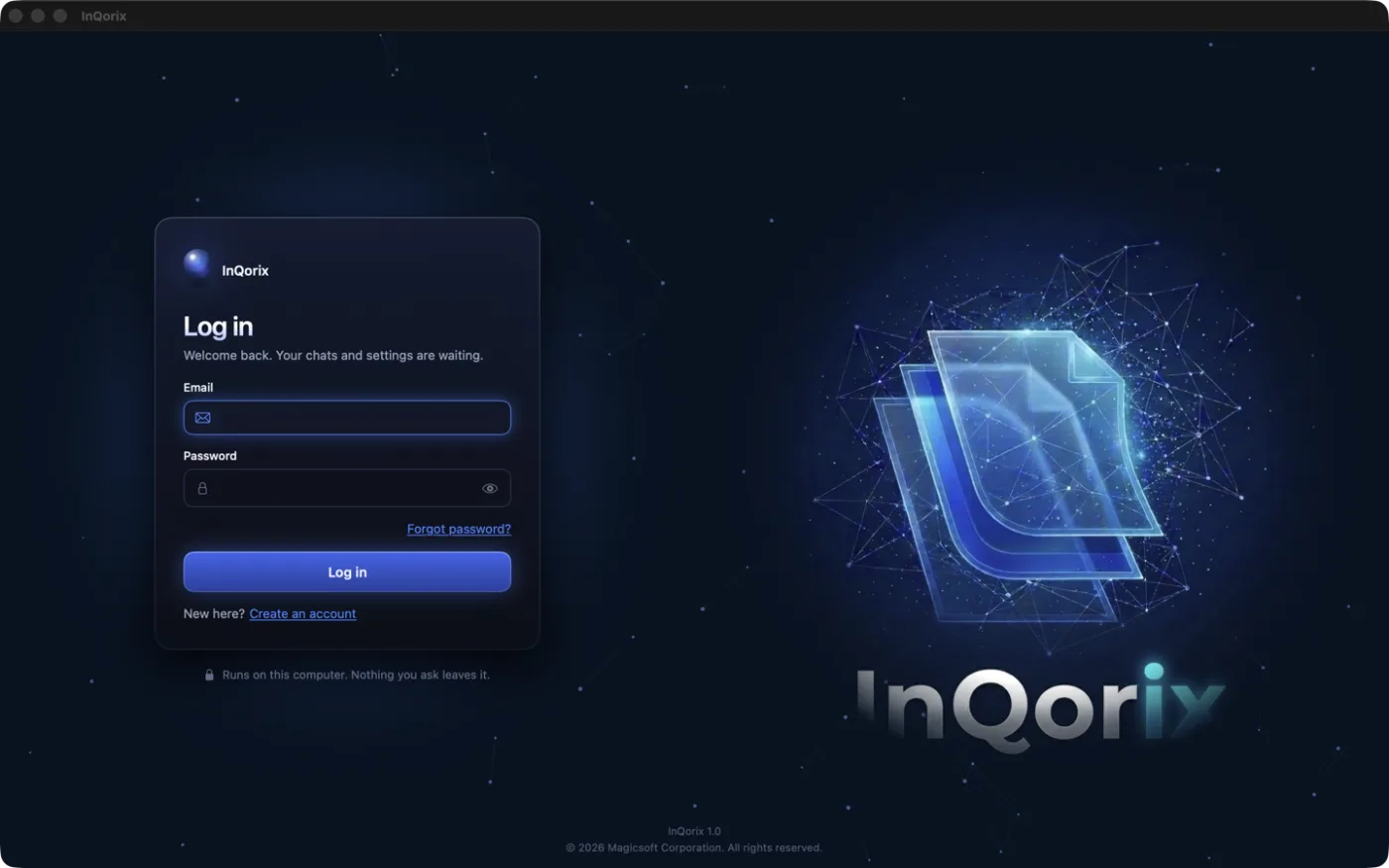
Earlier-build example; displayed names and versions are not release specifications.
To create your account: click Create an account, then enter your Full name, Email and a Password (at least 8 characters, with a number or symbol), and type the password again in Confirm password. Click Create account. You're logged in at once; there is no email to confirm.
To log in: enter your email and password and click Log in (or press Return). The app remembers the last email used on this Mac and fills it in for you.
If you forget your password: click Forgot password?. The card asks for your Account email (already filled in if the app knows it), a New password and Confirm new password. Click Set password and log in. Your password is changed at once, and you're logged in. This changes the local profile's password on this Mac.
Accounts are profiles on this Mac only. Accounts and chats do not sync between computers or follow you when you sign in elsewhere. They keep each person's chats and settings separate, but they aren't a security lock: anyone using this Mac can reset an account's password if they know its email. Keep your Mac's own login (your macOS password) private, and use it to protect sensitive work.
To log out: click Log out at the bottom of the sidebar, or in Settings → Account & About. The app stays logged in between launches until you log out.
To change your password: Settings → Account & About: enter your current password, then the new one twice, and click Change password.
3. Add a model
A model is the AI that writes the answers. Before your first question you need at least one. Models are files (in the GGUF format) of a few hundred megabytes to tens of gigabytes; the larger ones are smarter but slower and need more memory.
The easiest way: Discover. Open Settings (⌘, or the gear button at the top right) and choose Discover. It lists the models on Hugging Face, the largest public model library, most downloaded first.
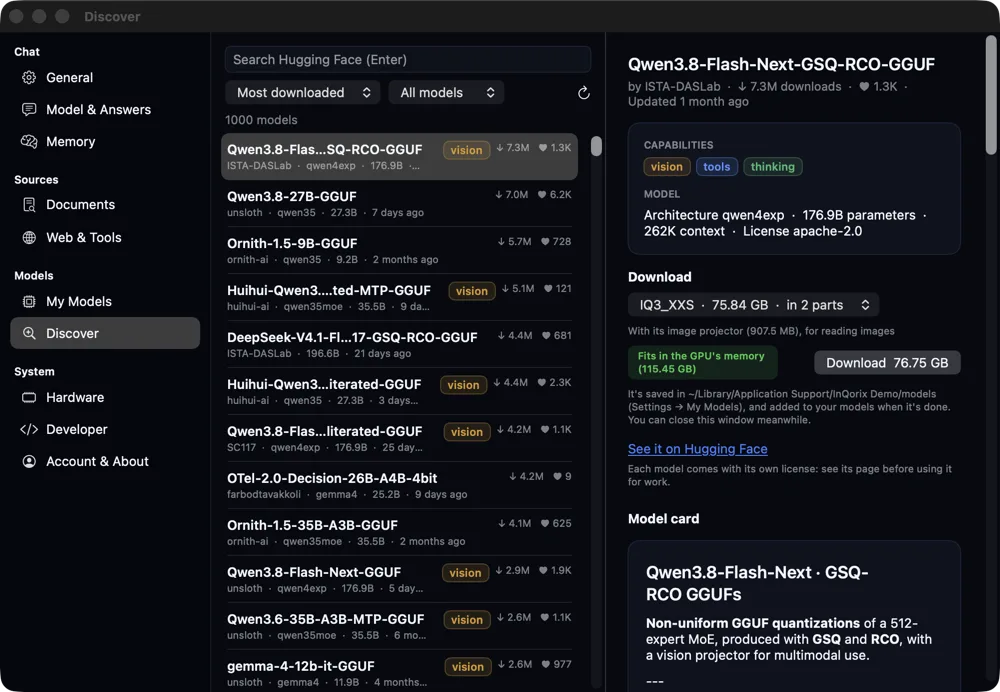
Earlier-build example; displayed names and versions are not release specifications.
- Search for a model, or pick one from the list. Good starting points are Qwen3 or Gemma models of 4B to 8B ("B" is billions of parameters; more is smarter and larger).
- On the right you see what it can do (vision, tools, thinking), its size, and whether it fits your Mac: green means it fits in the graphics memory, orange means it will run but more slowly, red means it is likely too large.
- Choose a size (a "quantization" such as Q4_K_M, a good balance of quality and size) and click Download. The download continues even if you close Settings, and the model is added when it finishes. Each download is checked against its published checksum.
Other ways: in Settings → My Models, click Add model files… to add .gguf files you already have, or copy
them into the models folder: they're added the next time you open My Models. The models Ollama and LM Studio
downloaded on this Mac are added the same way, used where they are.
Which model answers. After you log in, the app makes sure your chats have a model. If none is chosen, it uses the one you used last (or the only one there is). If you haven't used one yet, Settings → My Models opens for you to choose one (the top bar says Choose a model); with no models at all, Settings → Discover opens to get one. To switch later, click the model in the top bar.
The model's capabilities matter:
| Capability | What it means |
|---|---|
| tools | It can search your documents and the web as it thinks (needed for the Web switch) |
| thinking | It reasons step by step before answering (you can read its thoughts) |
| vision | It can look at pictures you attach |
| embedding | A helper model that turns text into numbers for searching; it doesn't chat. Other apps can use it through the local API service (section 16) |
4. The window at a glance
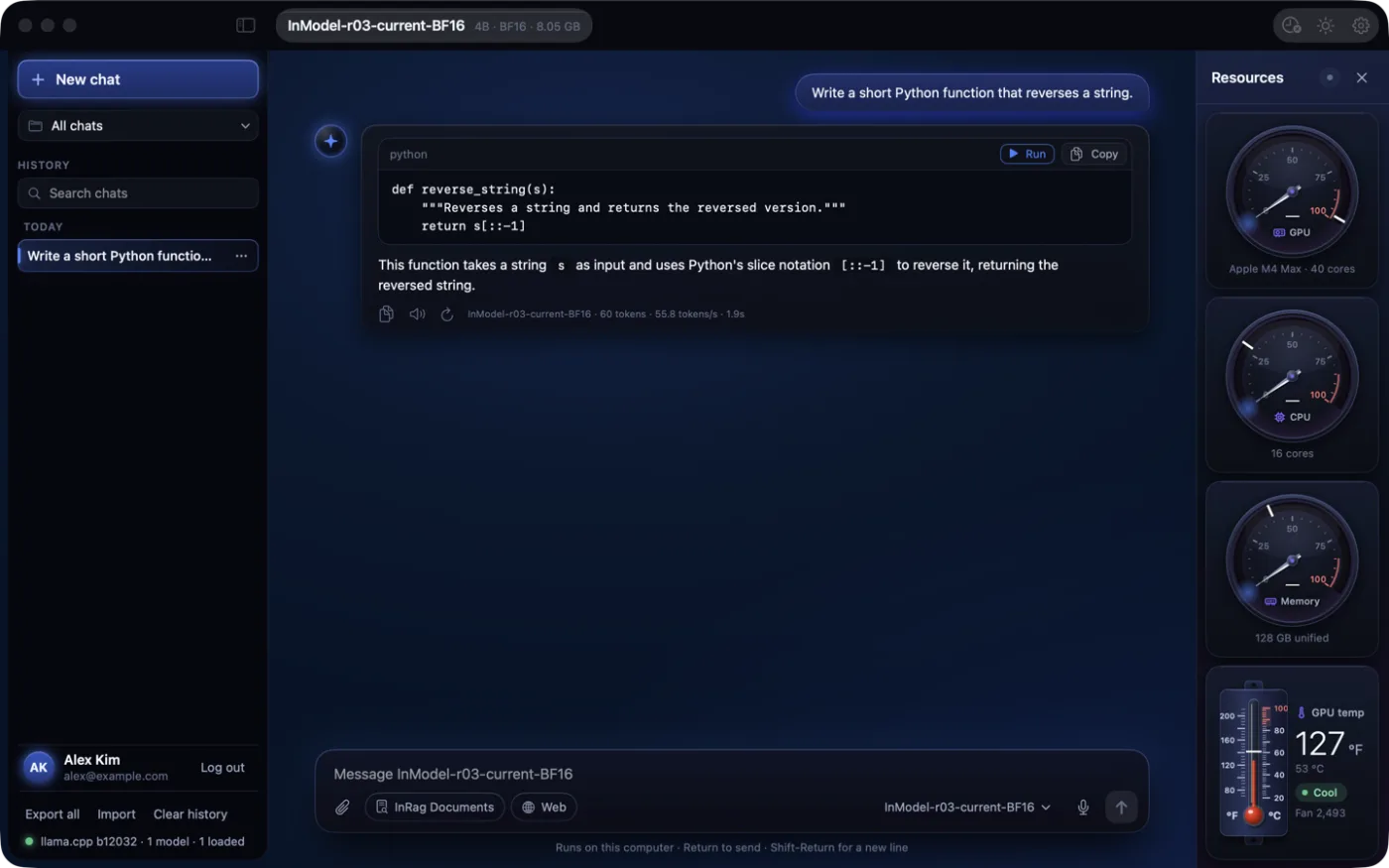
Earlier-build example; displayed names and versions are not release specifications.
The sidebar (left)
- New chat: starts a new conversation (⇧⌘N).
- All chats: the project picker (section 12).
- History: search box, then your chats, grouped as Pinned, Today, Yesterday, Previous 7 days, Previous 30 days and Older. The open chat is lit. Point at a chat to see its ⋯ menu.
- At the bottom: your name and email with Log out; Export all, Import and Clear history; and the engine's status: a green dot and, for example, "llama.cpp b12032 · 1 model · 1 loaded".
The top bar
- The model pill (left): the model that answers, with its size and details (such as "0.6B · Q4_0 · 429 MB"). "Loading…" shows while a model loads. Click it to open Settings → Model & Answers with the model list already open, to switch models at once. It says Choose a model when none is chosen yet, and Add a model when there are none.
- Temporary chat (clock), Theme (sun or moon) and Settings (gear) on the right.
The middle
- On a new chat, the welcome page: the greeting, the message box, and four suggestions to start from.
- In a chat, your questions on the right (blue bubbles) and the answers on the left, each in its own card.
The message box (bottom)
- Type your question. Return sends it; Shift-Return starts a new line.
- Paperclip: attach files or pictures. InRag Documents and Web: where the answer comes from. A green dot on a switch means it's on and ready.
- On the right: the model menu, the microphone for dictation, and Send (it turns red to Stop while an answer is being written).
- Under the box, a hint: where your question goes ("Runs on this computer", or which documents are searched) and how to send it.
5. Ask a question
- Click in the message box and type your question.
- Choose where the answer comes from with InRag Documents and Web (or leave both off).
- Press Return or click Send.
The answer appears as it is written. To stop it early, click Stop or press Esc.
The first question takes a moment longer: the model is loaded into memory first ("Loading…" in the top bar). After that, answers start right away. A model that isn't used for a while may be unloaded again to free memory (section 15).
Thinking. Models with thinking reason before they answer. The answer card shows Thought for N seconds; click it to read the reasoning. Turn thinking off in Settings → Model & Answers for faster, shorter answers.
Choose the model. Use the model menu in the message box, or Settings → Model & Answers. Each chat remembers which model answered each question.
Temporary chats. Click the clock button in the top bar to start a chat that isn't saved: it doesn't appear in your history and disappears when you open another chat. The hint under the message box says "Temporary chat: not saved". Click the clock again to leave it.
The suggestions on the welcome page fill in a question for you (or, for Ask about a file, open the file picker), so you can see how it works.
6. Answers from your documents
Turn on InRag Documents in the message box to have the answer come from documents. Documents are searched with InRag, Magicsoft's document search: it indexes your documents in collections, and the model looks up the passages that match your question, reads them, and answers from them, citing each one. InRag can run on this Mac or on your organization's file server or company server; your administrator tells you its address. (To see InRag, use the See it in a demo link on the Documents page, or visit magicsoft.io.)
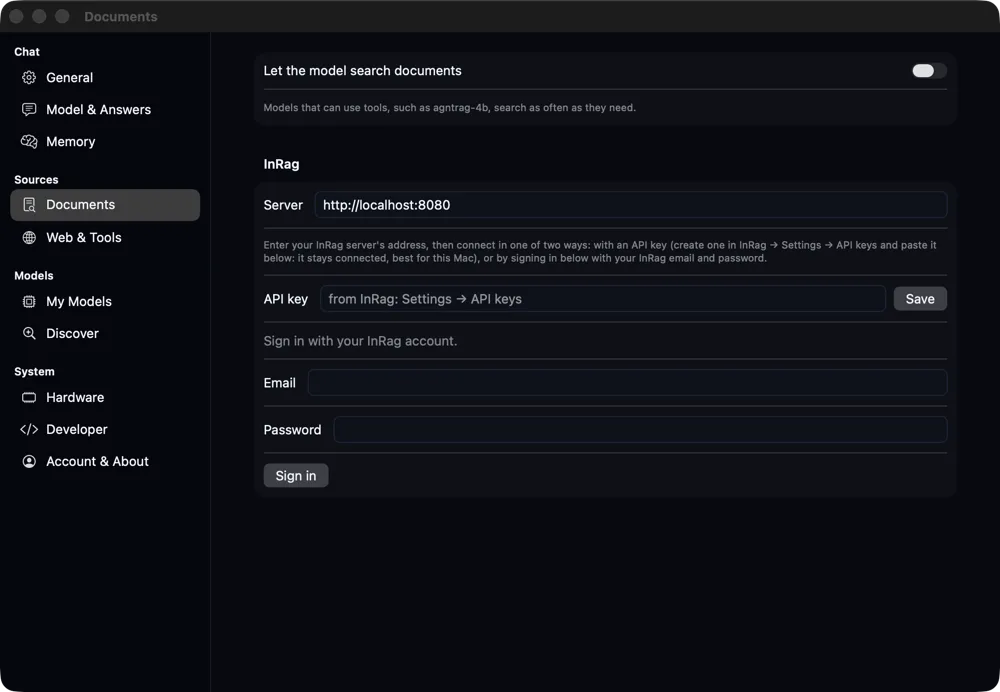
Earlier-build example; displayed names and versions are not release specifications.
Connecting to InRag
- In Settings → Documents, turn on Let the model search documents (or click InRag Documents in the message box: it turns it on and opens this page).
- Enter the Server address of your InRag. The app connects by itself a moment after you stop typing (there's no Connect button).
- Connect with either an API key (created in InRag, under Settings → API keys; paste it and click Save: it stays connected, best for this Mac) or your InRag email and password (Sign in).
- Choose a Collection, or All collections.
When connected, the InRag Documents switch shows a green dot. In an answer, a cited passage's document can be opened: PDFs and text open on your Mac, and other files (Word, Excel…) are saved where you choose.
It stays on only while InRag is connected. If InRag can't be reached, needs you to sign in, or turns down the API key, Let the model search documents turns itself off, so questions aren't sent to a search that can't answer; the card on this page says why. Once InRag connects (you sign in, or save a key that works), it turns back on by itself. If you turn it off yourself, it stays off.
A single file, without InRag. To ask about one file, attach it to your question with the paperclip (section 9): the model reads it for that answer. Searching a whole set of documents needs InRag.
How the search works. Models that can use tools search as often as they need, with their own search words. Others get one search with your question before they answer. If your documents have nothing about the question and Web is also on, the web is searched next.
7. Answers from the web
Web search is off when you first open the app. Other connected features can still use the network. Turn on Web in the message box. The model then searches Wikipedia first and, if needed, the wider web (DuckDuckGo), and answers from what it finds.
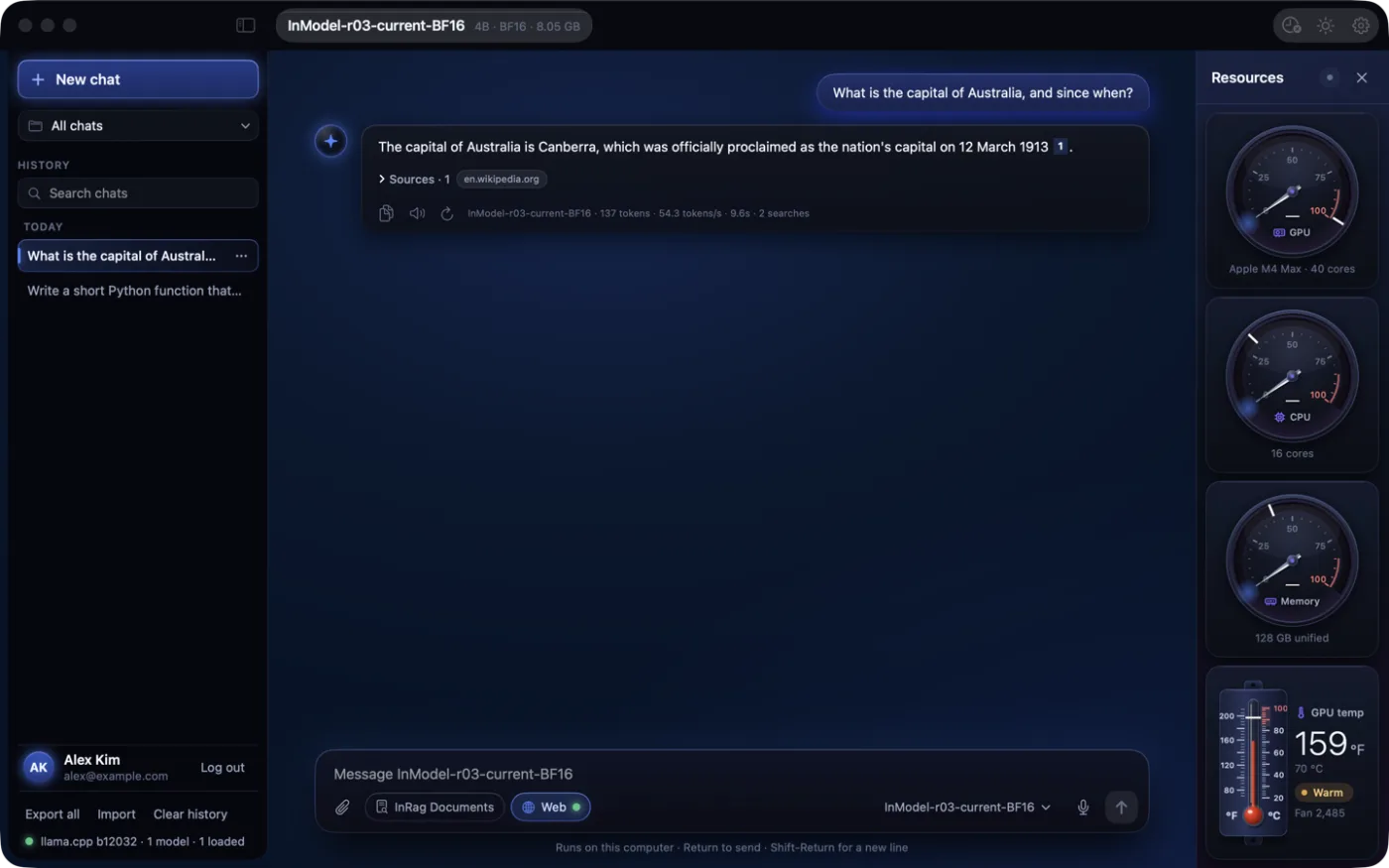
Earlier-build example; displayed names and versions are not release specifications.
- The answer card shows the step Searched the web for "…" with the number of results. Click it to see them.
- Numbered citations such as 1 mark where each statement came from.
- Sources · N lists the pages cited.
Web search needs a model that can use tools. With a model that can't, the Web switch is dimmed; point at it to see why.
Always check the sources for anything important. In the example above, the model says Canberra was established after federation in 1901; in fact it became the capital in 1913. The citation lets you check exactly that. Small models in particular can misread what they find.
8. Read, check and reuse the answer
Each answer card has, at its bottom:
- Copy: copies the whole answer.
- Read aloud (speaker): reads the answer in your Mac's voice. Click again, or press Esc, to stop.
- Regenerate (circular arrow): writes the answer again. The earlier answers are kept: use the ‹ 1 / 2 › arrows to switch between versions.
- The details: the model, the number of tokens (pieces of words), the speed, and the searches made.
Citations and Sources. Click a numbered citation to see the passage it came from. Open Sources to see every document or page used.
The steps. Searches show as steps above the answer, with their results: Searched "…" (your documents), Read a document (when the model opens one to read more), and Searched the web for "…". Click a step to see what it found.
Edit a question. Right-click your question (the blue bubble) and choose Edit. Change it and click Send: the answer is written again for the new question, and the earlier version is kept. Copy copies the question.
Formatting. Answers are formatted: headings, lists, tables, links, and code blocks with their language. Select any text to copy part of an answer.
9. Attach files and pictures, and dictate
Attach files. Click the paperclip, or drag files onto the message box. You can attach PDFs (with text, not scanned pages) and text files (plain text, Markdown, CSV, code and similar): the model reads their text with your question. Word and Excel files aren't read; save them as PDF first. Long files are cut to fit what the model can read.
Attach pictures. With a model that has vision, attach images (PNG, JPEG, HEIC and others) to ask about them. Other models can't see pictures; the app tells you if you try.
The attachments show above the message box; click × to remove one before sending.
Dictate. Click the microphone and speak: your words appear in the message box as you talk. Click it again to stop. The first time, macOS asks to let the app use the microphone and speech recognition: click Allow. Speech recognition runs on your Mac when on-device recognition is available; otherwise, audio may be sent to Apple's servers for recognition. See the app data-flow table.
10. Code, previews and diagrams
Code and network access: Code runs and generated previews can make network requests. Review code before running it and pages before previewing them.
Code in answers appears in code blocks, with the language name and, at the top right:
- Copy: copies the code.
- Run (for Python and JavaScript): runs it, inside the app, and shows the output under the block. Python uses a bundled runtime; extra packages (such as numpy) may download when code uses them. Code itself can make network requests.
- Preview (for HTML, SVG and Mermaid diagrams): opens a panel on the right showing the page, picture or diagram. Switch between Preview and Code, Download it, or close the panel (Esc).
Code runs inside the app. Treat generated code and pages as executable content; their network requests can send data to other services.
11. Your chats
Every chat is saved (except temporary chats) and listed in the sidebar's History, newest first.
- Search chats: type words to find chats containing all of them, in titles, questions or answers.
- The ⋯ menu (point at a chat), or right-click a chat:
- Pin to top / Unpin: pinned chats stay above the others.
- Rename.
- Move to project (section 12).
- Export: as Markdown (.md), a Web page to share (.html), or a Backup (.json).
- Archive / Unarchive: archived chats leave the history; Show archived chats at the bottom of the history brings them back into view.
- Delete.
- Export all (bottom of the sidebar): saves every chat, project, preset and memory to one backup file. This does not sync or transfer your local account.
- Import: loads chats from an export, including ChatGPT's
conversations.jsonexport. - Clear history: deletes all your chats, after asking you to confirm. This can't be undone.
12. Projects
A project groups chats about one subject, with its own instructions and reference files sent with every chat in it.
- Create one: open the All chats picker at the top of the sidebar and choose New project…. Give it a Name, optional Instructions (for example "Answer as our HR policy advisor. Be concise."), and add Files the model should know about. Click Save.
- Work in a project: choose it in the picker. The history shows only its chats, and new chats start in it.
- Edit it: choose it, then click the pencil beside the picker. Delete project is there too; its chats stay, outside any project.
- Move a chat: ⋯ → Move to project.
13. Memory
The app can remember facts about you, such as your role or preferences, and use them in every chat.
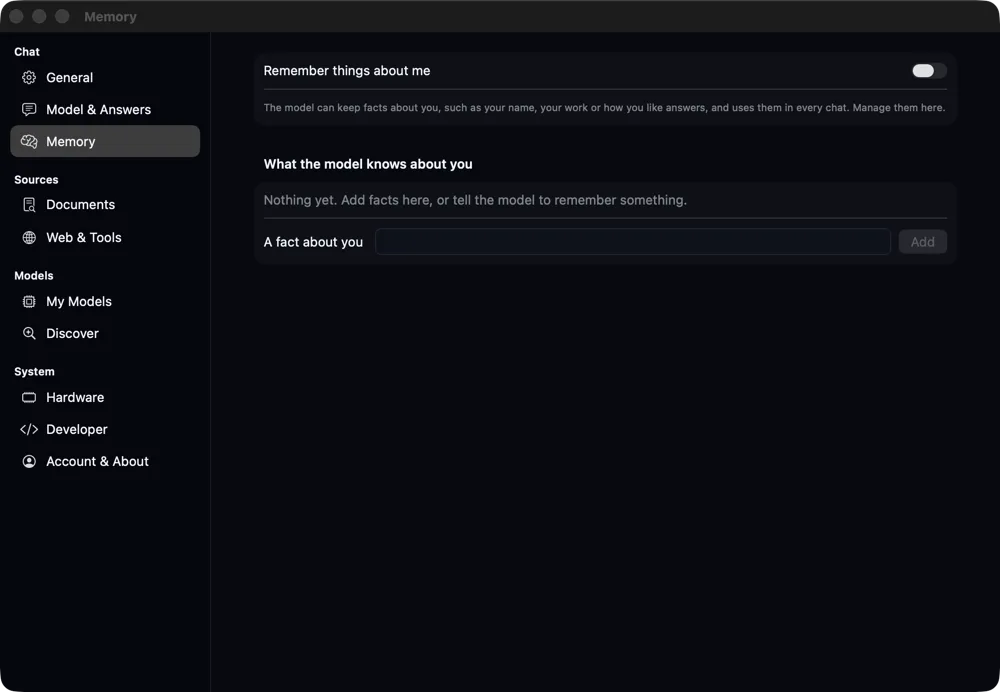
Earlier-build example; displayed names and versions are not release specifications.
- Turn on Remember things about me in Settings → Memory.
- Add facts yourself under What the model knows about you (type one and click Add), or tell the model in a chat: "Remember that I work in the finance team."
- Forget removes a fact.
14. Settings
Open Settings with ⌘, or the gear in the top bar. The pages are in four groups in the sidebar.
Chat
General: Theme (Dark blue, or Classic, which follows your Mac's light or dark appearance; the sun or moon button in the top bar switches too), Text size (Small to Larger), and Send with (Return, or ⌘-Return if you often write multi-line questions).
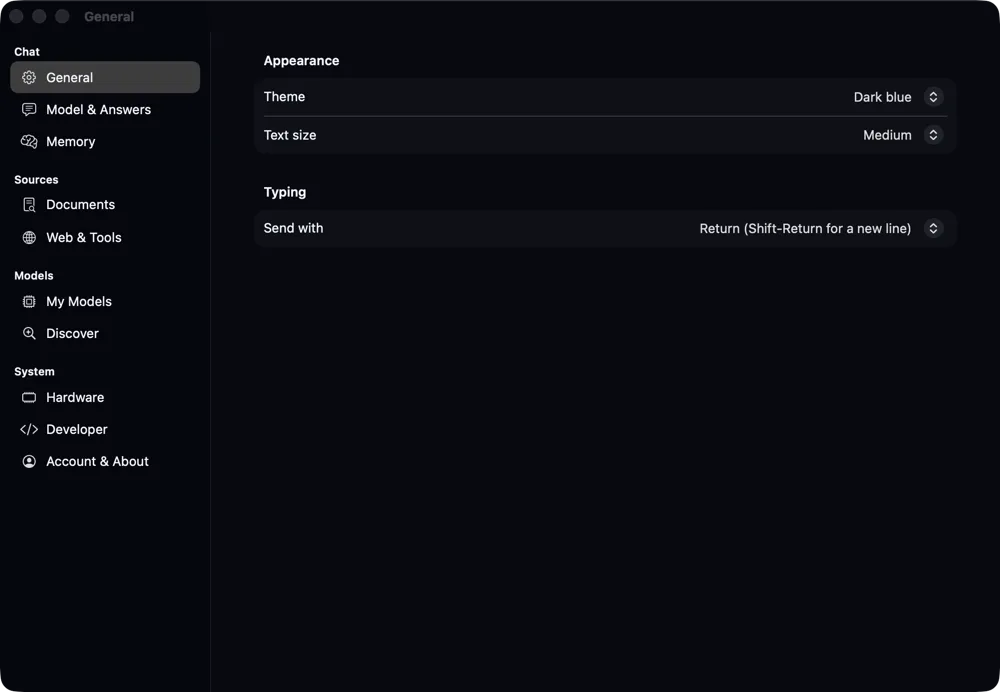
Earlier-build example; displayed names and versions are not release specifications.
Model & Answers: everything about how answers are written.
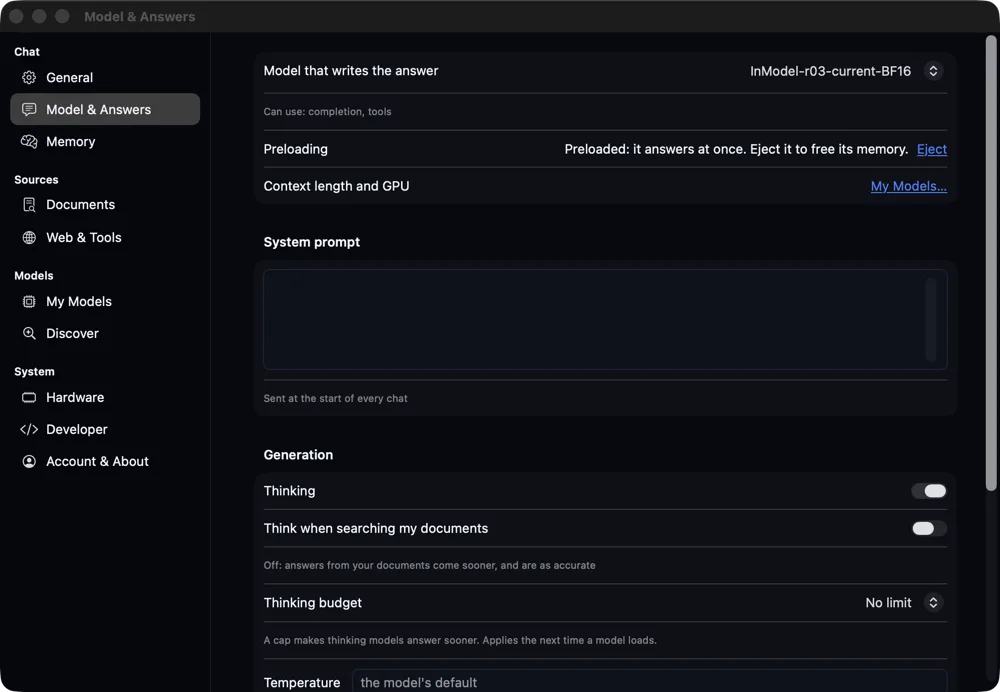
Earlier-build example; displayed names and versions are not release specifications.
- Model that writes the answer: the list of your models (clicking the model in the top bar opens this page with the list open). It shows Choose a model until one is chosen; its last item, Add another model…, opens Discover. Under it: what the model can do, whether it's loaded (with Load and Eject), and a link to its Context length and GPU settings in My Models.
- System prompt: instructions sent at the start of every chat (for example "Answer in American English").
- Generation:
- Thinking on or off.
- Thinking budget: how long a thinking model may think before answering (No limit, or 512 to 8,192 tokens). A cap gives faster answers.
- Temperature: higher is more creative, lower is more focused; empty uses the model's own default.
- Earlier turns sent: how many earlier question-and-answer pairs are sent with each new question (the chat's memory).
- Presets: save the current settings under a name, and Use them later in one click.
Memory: section 13.
Sources
Documents: section 6.
Web & Tools: Let the model search the web (the same as the Web switch). With Developer mode on, MCP servers appear here too (section 16).
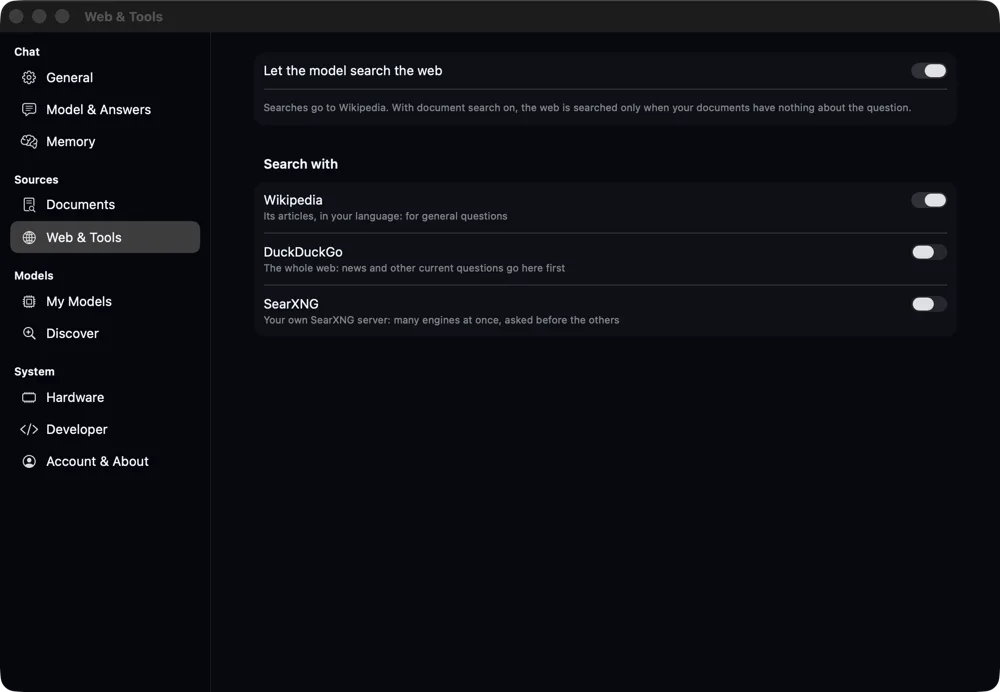
Earlier-build example; displayed names and versions are not release specifications.
Models
My Models: the models on this Mac.
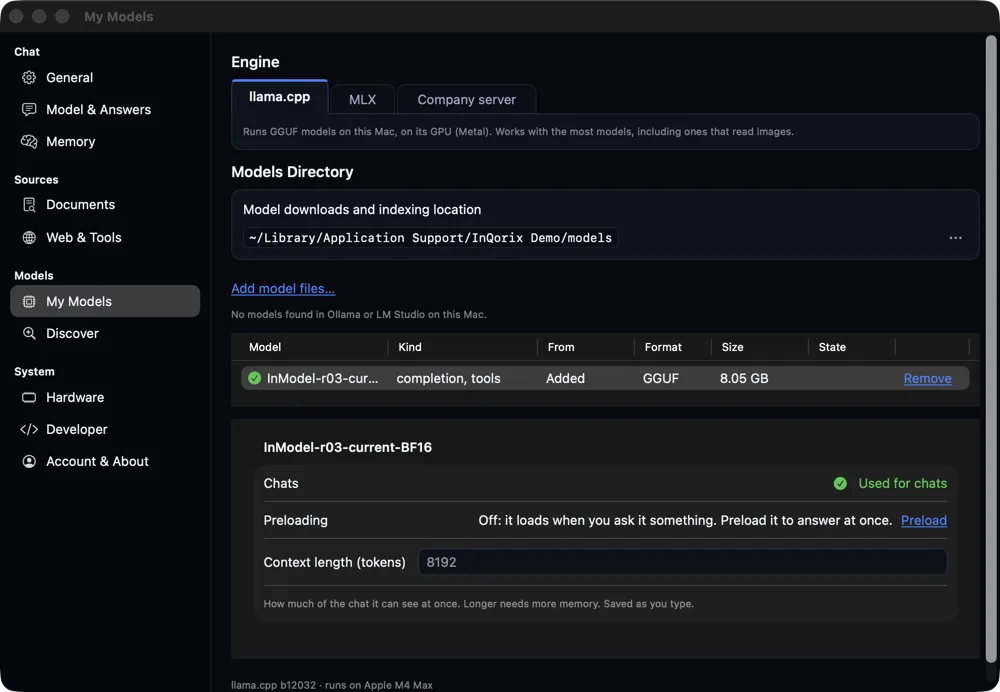
Earlier-build example; displayed names and versions are not release specifications.
- Engine: tabs for llama.cpp (GGUF models), MLX (Apple's own format, often faster on Apple silicon; the default when it's available on this Mac) and Company server (models on a server of your organization's).
- Models Directory: where models are downloaded and looked for. Click ⋯ to Change… it (for example to an external drive), Show in Finder, or Use the default folder.
- Add model files… (Add a model folder… with MLX). Opening the page adds the models in the models folder and Ollama's and LM Studio's.
- The list: each model's kind, size and state (loaded or not); a tick marks the one your chats use. Remove takes a model off the list, and can delete its files if they're in the models folder.
- Choosing the model for your chats: with none chosen yet, click a model in the list and it's chosen (a note says Chats use … now). Otherwise click a model, then Use for chats under the list (the chosen one says Used for chats).
- Click a model to see its settings below the list: Load or Eject, and its Context length (how much of the chat it can see at once; longer needs more memory). Changes are saved as you type, and the model reloads with them on your next question. The model whose settings you change becomes the one your chats use.
- At the bottom: the engine's version and the graphics chip it runs on.
Discover: section 3.
System
Hardware and Developer: sections 15 and 16.
Account & About: your account (change password, log out), Updates and App Info.
Updates: InQorix checks once a day whether a newer version is out and, if so, shows a notice at the top of the window: Download opens the download page in your browser, What's new the release notes, and Skip this version hides it until the next one. Turn off Check for updates once a day to stop the check, or click Check now at any time. The app never downloads or installs anything by itself.
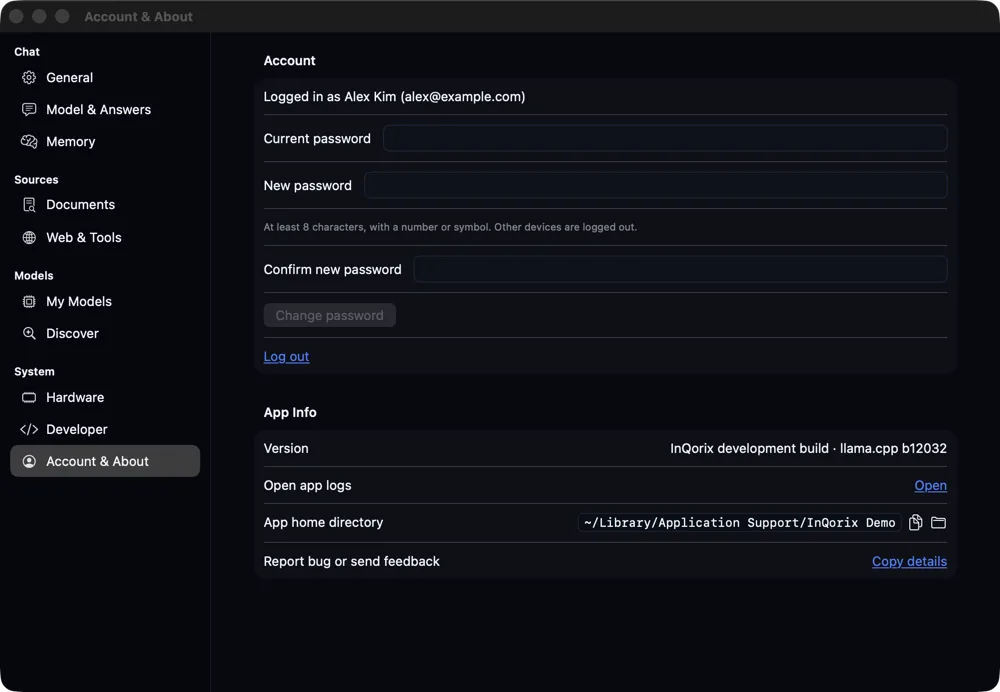
Earlier-build example; displayed names and versions are not release specifications.
- Version: the app's and the engine's.
- Open app logs: opens the engine's log, useful for support.
- App home directory: where the app keeps your data, with buttons to copy the path or show it in Finder.
- Report bug or send feedback: Copy details copies a ready-made report (versions, your Mac's hardware, the model in use, and the engine's last log lines); Email support opens an email to support@magicsoft.com to paste it into. (If your organization set its own feedback page, the button opens that instead.)
15. Hardware, gauges and guardrails
Settings → Hardware shows your Mac and keeps models that are too large from slowing it down.
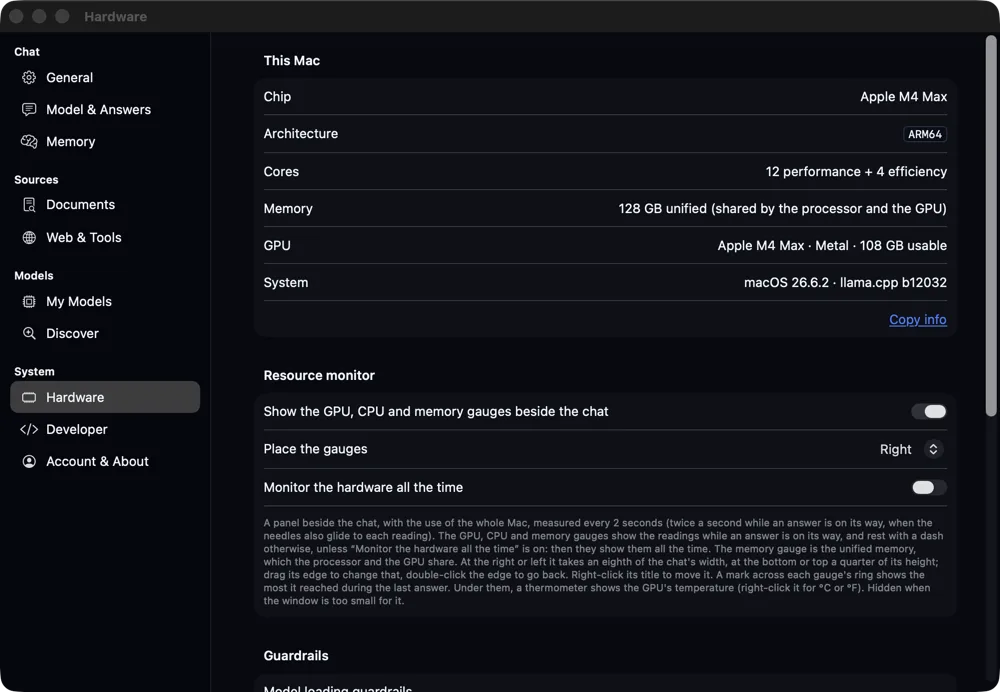
Earlier-build example; displayed names and versions are not release specifications.
The resource gauges
The Resources panel beside the chat shows how much of this Mac is in use, by every app:
| Gauge | Shows |
|---|---|
| GPU | How busy the graphics chip is, with its name and cores |
| CPU | How busy the processor is, across all its cores |
| Memory | The memory in use, for example 35.0 of 128 GB unified (the processor and the GPU share it) |
| GPU temp | A thermometer: the GPU's temperature, its state (Cool, Warm…) and the fan speed. Right-click it for °C or °F |
The gauges update every 2 seconds, and twice a second while an answer is being written (the badge at the top then says Answering). While an answer is written the needles glide to each reading; otherwise they step to it, which keeps the gauges from keeping the graphics chip busy. During an answer, a mark across the ring of each gauge records the highest reading, and stays until the next answer.
- Settings → Hardware → Monitor the hardware all the time makes the gauges read all the time (the badge then says Monitoring); otherwise they read only while an answer is on its way, and show a dash in between.
- Place the gauges (in Settings → Hardware, or right-click the panel's title) puts the panel at the Right, Bottom, Left or Top of the chat. Drag its edge to make it bigger or smaller; double-click the edge to go back to the first size.
- Hide it with its ×, or with Settings → Hardware → Show the GPU, CPU and memory gauges beside the chat. It also hides when the window is too small for it, and stops reading while the window is minimized or covered.
This Mac and guardrails
This Mac: the chip, the processor cores, the memory (on Apple silicon, the processor and graphics share it), the graphics memory models may use, and the macOS and engine versions. Copy info copies it all.
Guardrails. A model larger than your Mac's memory makes the whole Mac very slow. Before each model loads, the app estimates the memory it needs (the model plus its context) and compares it with the guardrail:
| Guardrail | Refuses a model larger than… |
|---|---|
| Off (not recommended) | Nothing is refused |
| Relaxed | All of your Mac's memory |
| Balanced (recommended) | What the graphics chip may use |
| Strict | The memory free right now, beside your other apps |
| Custom | The size you set, in GB |
A refused model shows a message in the answer card saying how much it needs and what's allowed, and what you can do: pick a smaller model or size, lower its context length, or change the guardrail. If another loaded model is in the way, it is ejected first to make room.
Loaded models
- Models loaded at once (1 to 3): more lets you switch models without waiting, but takes more memory.
- Unload a model when idle: after 5, 15 or 30 minutes or an hour without use, a model's memory is freed; it loads again with your next question.
16. Developer features
These are for technical users. Turn on Developer mode in Settings → Developer to see them; it also shows advanced settings elsewhere: each model's GPU setting (in My Models), InRag's passages per search and search threshold (in Documents), and MCP servers (in Web & Tools).
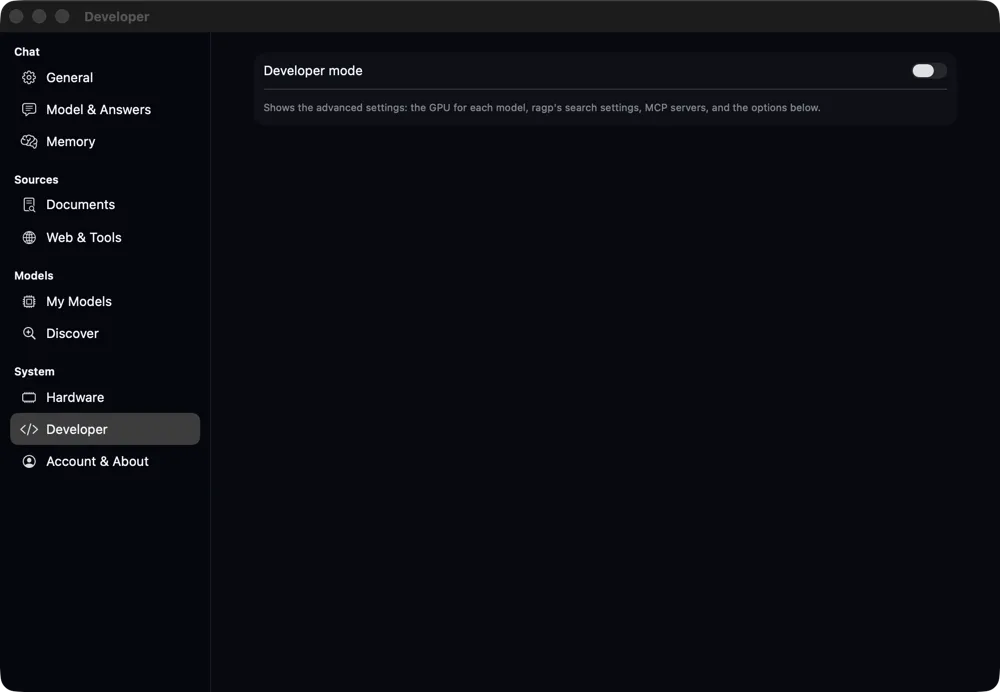
Earlier-build example; displayed names and versions are not release specifications.
Local API service. Turn on Serve the models to other apps on this Mac to let other programs (code editors, scripts) use your models through an OpenAI-compatible API:
- Base URL:
http://127.0.0.1:8091/v1(the port can be changed). Only this Mac can connect. - API key: apps must send it. Show, copy, or make a New key (apps using the old one stop working).
- Model names: the names to use in requests.
- Try it: a ready-to-copy
curlexample. - Restart the engine now applies changes at once.
Engine log level: how much detail the engine writes to its log (Errors, Warnings, Info, or Everything).
Show debug info under answers: a Debug info section under each answer, with each request to the model, the time to the first word, token counts and speeds, the tool calls, and the guardrail's check.
Show the engine's memory and processor use in the sidebar: a line such as "Engine: 1.0 GB · CPU 4%".
MCP servers (Web & Tools): connect tool servers using the Model Context Protocol; their tools are offered to models that can use tools.
Pre-filled links. A link such as enterpriseaichat://chat?model=…&prompt=Hello&send=1 opens the app with a
question ready (and sends it with send=1). Also understood: system, temperature, preset, and temporary=1.
17. Keyboard shortcuts
| Keys | Action |
|---|---|
| Return | Send the question (or a new line, if Send with is ⌘-Return) |
| Shift-Return | New line in the question |
| ⌘-Return | Send, when Send with is set to ⌘-Return |
| Esc | Stop the answer being written; stop reading aloud; close the preview panel |
| ⇧⌘N | New chat |
| ⌘, | Open Settings |
| ⌘C | Copy selected text |
| ⌘Q | Quit (the engine and its models stop too) |
18. Tips for good questions
- Say what you want and for whom. "Summarize this policy in five bullet points for new staff" works better than "summarize".
- Give the context. Attach the file, or turn on InRag Documents for questions about your organization.
- One task at a time. Ask follow-up questions in the same chat; the model sees the earlier turns.
- Check important facts in the Sources, especially numbers, dates and names.
- Use Regenerate if an answer misses the point, or Edit your question to make it clearer.
- Pick the right model. Larger models reason better; smaller ones answer faster. Models with thinking are better at multi-step problems.
19. Where your data is kept
The app stores local data on your Mac in ~/Library/Application Support/Enterprise AI Chat (Settings → Account & About →
App home directory):
- your account (the email, name and a protected form of your password; the password itself is never stored),
- your chats, settings, projects, presets and memory,
- the models you downloaded (unless you chose another models folder),
- the engine's log.
Secrets (your login, the InRag and API keys) are encrypted. Builds signed with your organization's Developer ID keep the encryption key in your macOS Keychain; other builds keep it in a file only your Mac account can read.
Network use: company model servers receive the conversation, attachment text, memory, project context and document passages needed to answer. Web search sends search terms; InRag receives sign-in and search requests, and the app checks its connection at startup. Discover contacts Hugging Face, MCP tools receive their inputs, and code runs may download Python packages. Generated code and pages can make their own network requests. Dictation may send audio to Apple's servers when on-device recognition is unavailable. See the app data-flow table for destinations and details.
20. Problems and what to do
| Problem | What to do |
|---|---|
| "Add a model" in the top bar, or no models | Download one in Settings → Discover, or add a .gguf file in My Models (section 3) |
| "Choose a model" in the top bar | Click it and pick a model from the list, or click one in Settings → My Models |
| The first answer takes a while | The model is loading into memory ("Loading…" in the top bar); later answers start at once |
| "…needs about N GB of memory… the guardrail allows…" | The model is too large for this Mac at that setting. Pick a smaller model or size, lower its context length (My Models), or change the guardrail (Settings → Hardware) |
| The Web switch is dimmed | The model can't use tools; choose one with tools in its capabilities |
| Web search finds nothing or fails | Check your internet connection; try again in a few minutes (the search service may be busy) |
| InRag Documents turned itself off | InRag isn't connected: open Settings → Documents to see why (sign in, save a working API key, or check the Server address). It turns back on once InRag connects |
| InRag Documents has no green dot | Settings → Documents: check the InRag server address and the sign-in or API key |
| The engine shows a red dot or "Engine not running" | Quit and reopen the app. If it persists, Settings → Account & About → Copy details and send them to support |
| The Mac becomes slow while answering | Use a smaller model, set the guardrail to Balanced or Strict, or load fewer models at once (Settings → Hardware) |
| Answers are cut short or forget earlier messages | Raise the model's context length (My Models), or Earlier turns sent (Model & Answers) |
| Dictation doesn't start | System Settings → Privacy & Security: allow InQorix under Microphone and Speech Recognition |
| Read aloud says there's no voice | Add a voice in System Settings → Accessibility → Spoken Content |
| Forgot your password | Forgot password? on the login screen (section 2) |
| API service: "Port … is taken" | Another program uses that port; choose another in Settings → Developer |
| Anything else | Settings → Account & About → Report bug or send feedback |